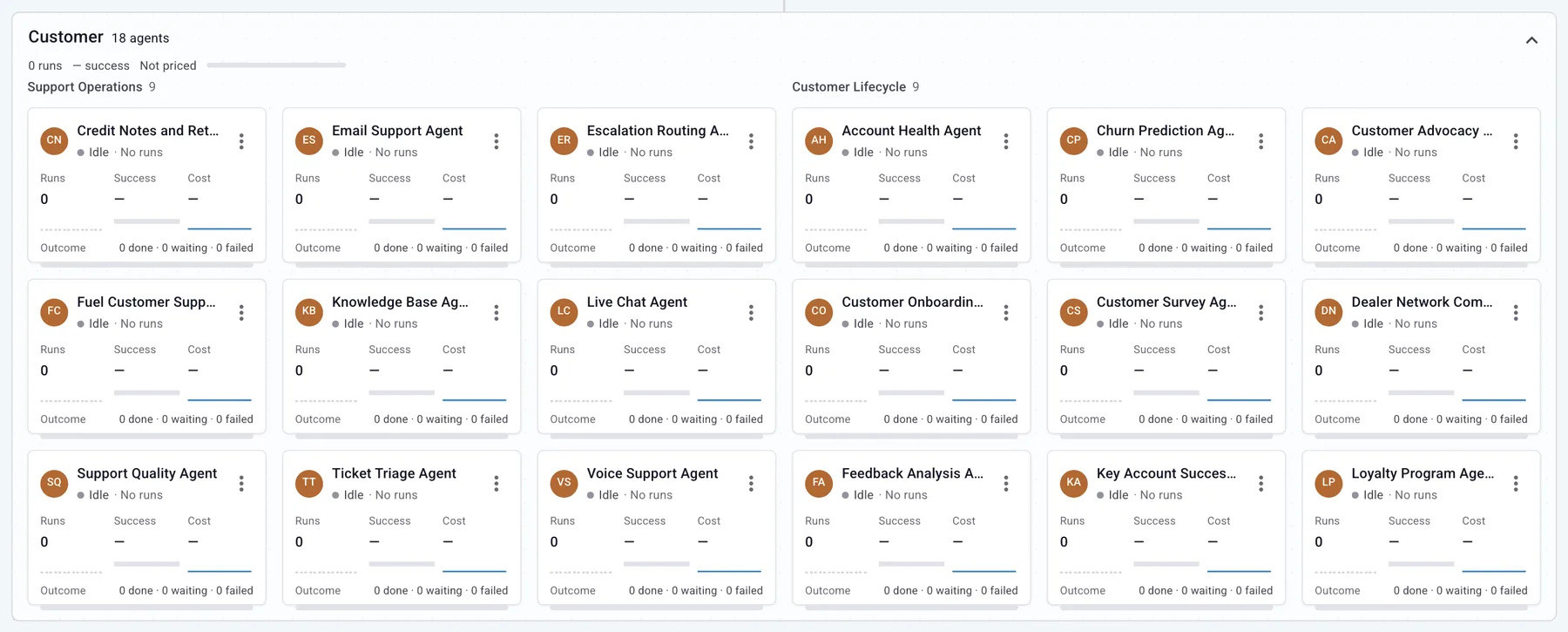
We wrote 163 agents for a whole company, then rewrote every one for seven industries: 1,141 in all. Before showing them to anyone, we ran one agent in every department of every industry: 77 runs. Every run reached its approval step or finished.
The details in those runs were made up for the test, and the agents said so. That turned out to be the most useful thing we learned.
The agents never invent facts
A hotel’s Guest Support Agent was asked for an illustrative example with no hotel, guest or reservation behind it. It declined to invent details, because they would be presented as facts, and asked for what it needed to open a real case. A bank’s Customer Support Agent found no records and nothing relevant in its knowledge base, and said the cause of the decline and the fee tariff were unconfirmed.
When a record is missing, the agent says so and asks for it. It does not make up a number to fill the gap.
Stopping is a feature
Every agent follows the same steps: look it up, read the request, check the facts, forecast when it decides, work it through, ask a person, act. The sixth step is where trust is built. When its rules say so, the agent stops and shows the approver a plain summary. The approver can approve it, edit it or send it back, and nothing is sent or changed until they do.
Five agents always stop, in every industry: Payroll, Accounts Payable, Refunds and Returns, Contract Preparation and CV Screening. Money and commitments stay with people.
Limits are settings, not code
The point at which an agent stops is not buried in a prompt. It is a setting: a refund limit, a price tolerance, a goodwill cap, an approval threshold. A manager can see it on the agent’s page and change it without a developer. That is what makes it possible to start cautiously and loosen limits as confidence grows.
What this means for your first agent
Start with an agent whose approver is easy to name and whose rules are already written down somewhere in your business. Read its settings with that approver before it runs. Then look at what it puts in front of them, and decide together what to change.